https://console.gmicloud.ai/user-console/ce/containers
Container workload management. Gated by product entitlement.
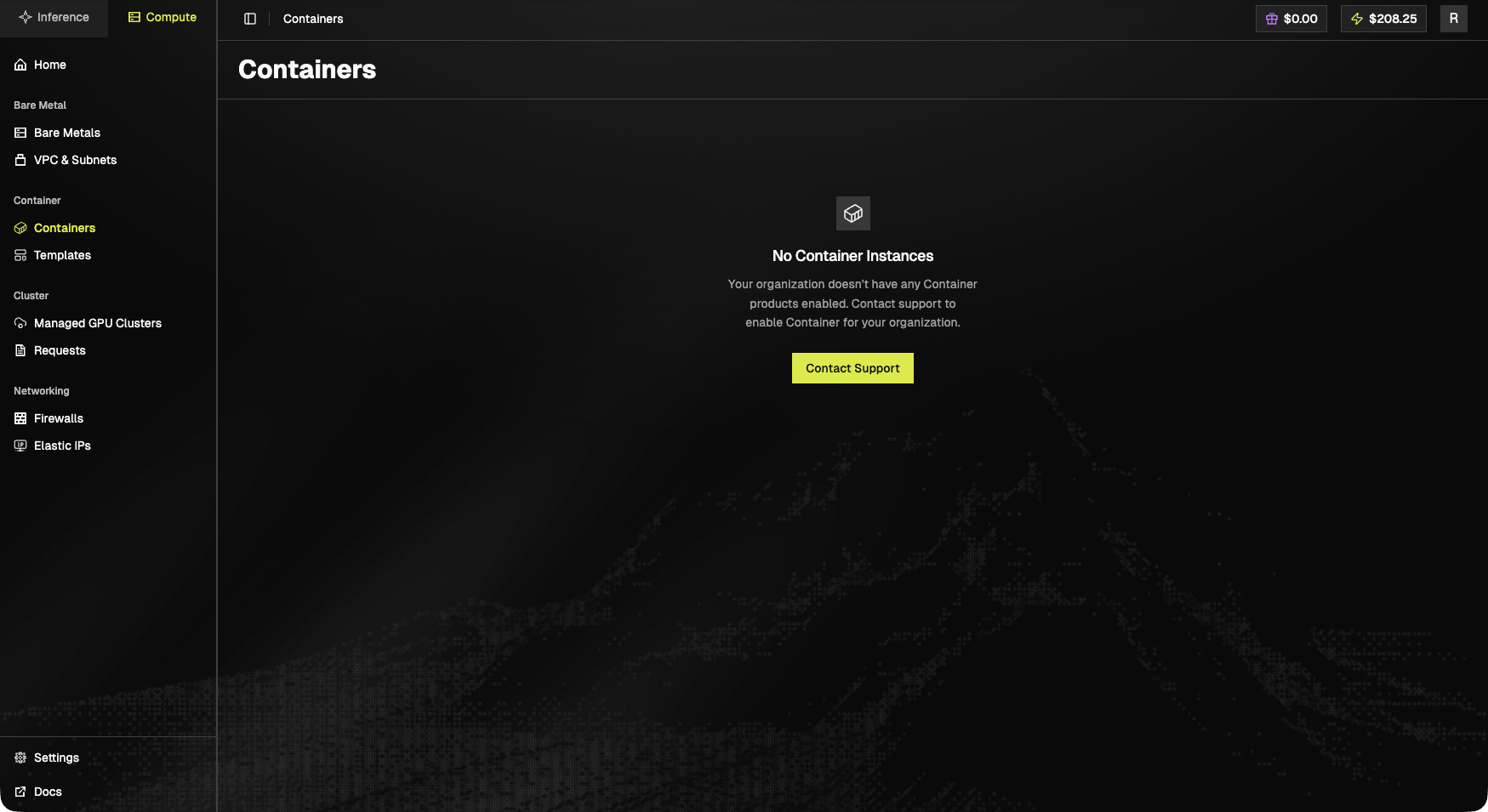
Gated state
If your organization hasn’t been enabled for Container products yet:No Container Instances. Your organization doesn’t have any Container products enabled. Contact support to enable Container for your organization.A Contact Support button is shown.
Enabled state
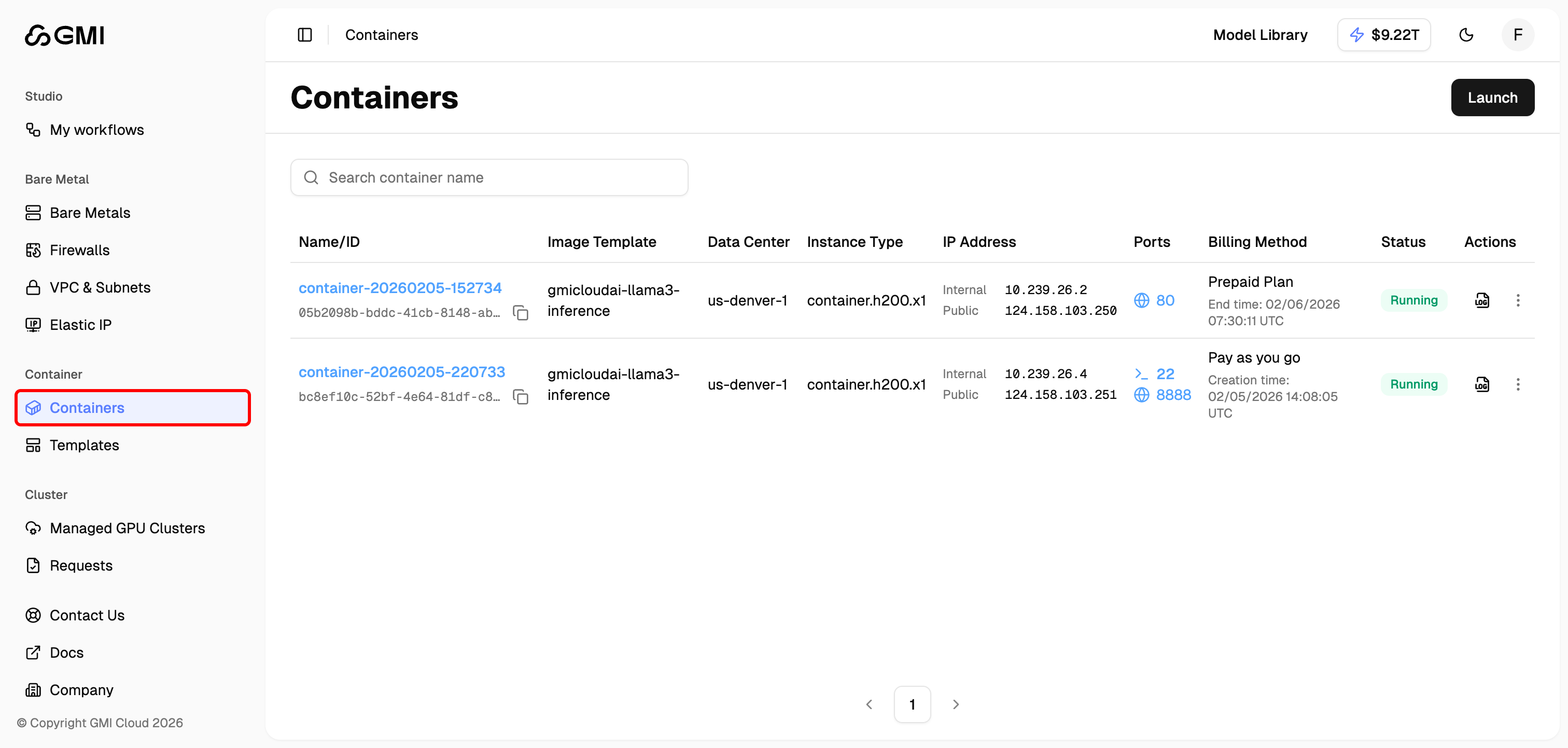
When populated, the page lists each container instance with name, status, image, template, attached firewall, and per-instance actions.Open the Containers list
To open the Containers list, click “Cluster” in the top navigation bar and select “Containers”.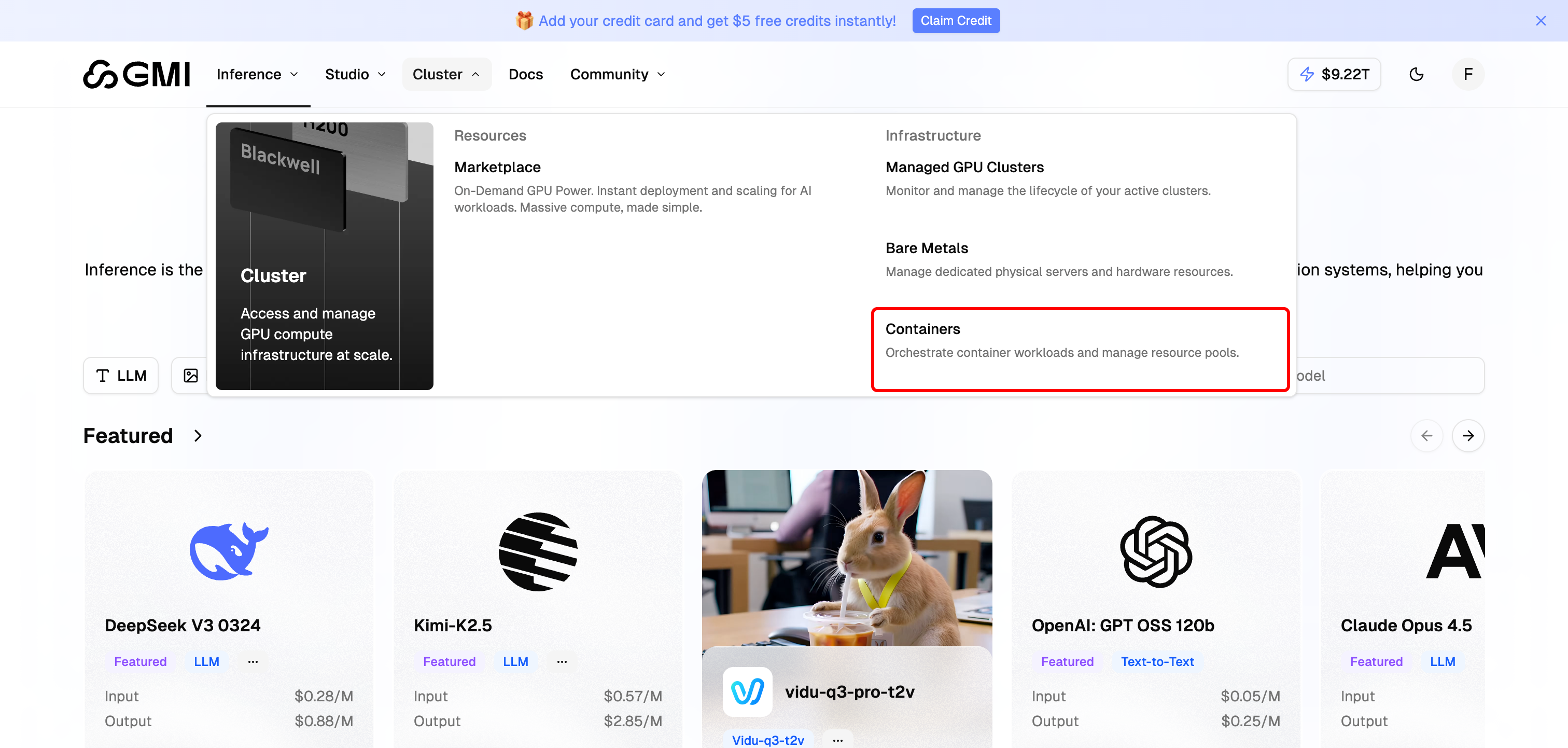
Access Containers
There are three ways to interact with a running container: SSH (from your own terminal), Jupyter Notebook (web-based), or the built-in web shell (no local tools required).SSH (port 22) and Jupyter Notebook (port 8888) are only available on containers launched from an official template that pre-configures these ports. Custom templates don’t expose them by default, use the web shell instead, or set up your own port mapping.
Connect via SSH
- Locate a container and click the port “22” icon in the “Ports” field
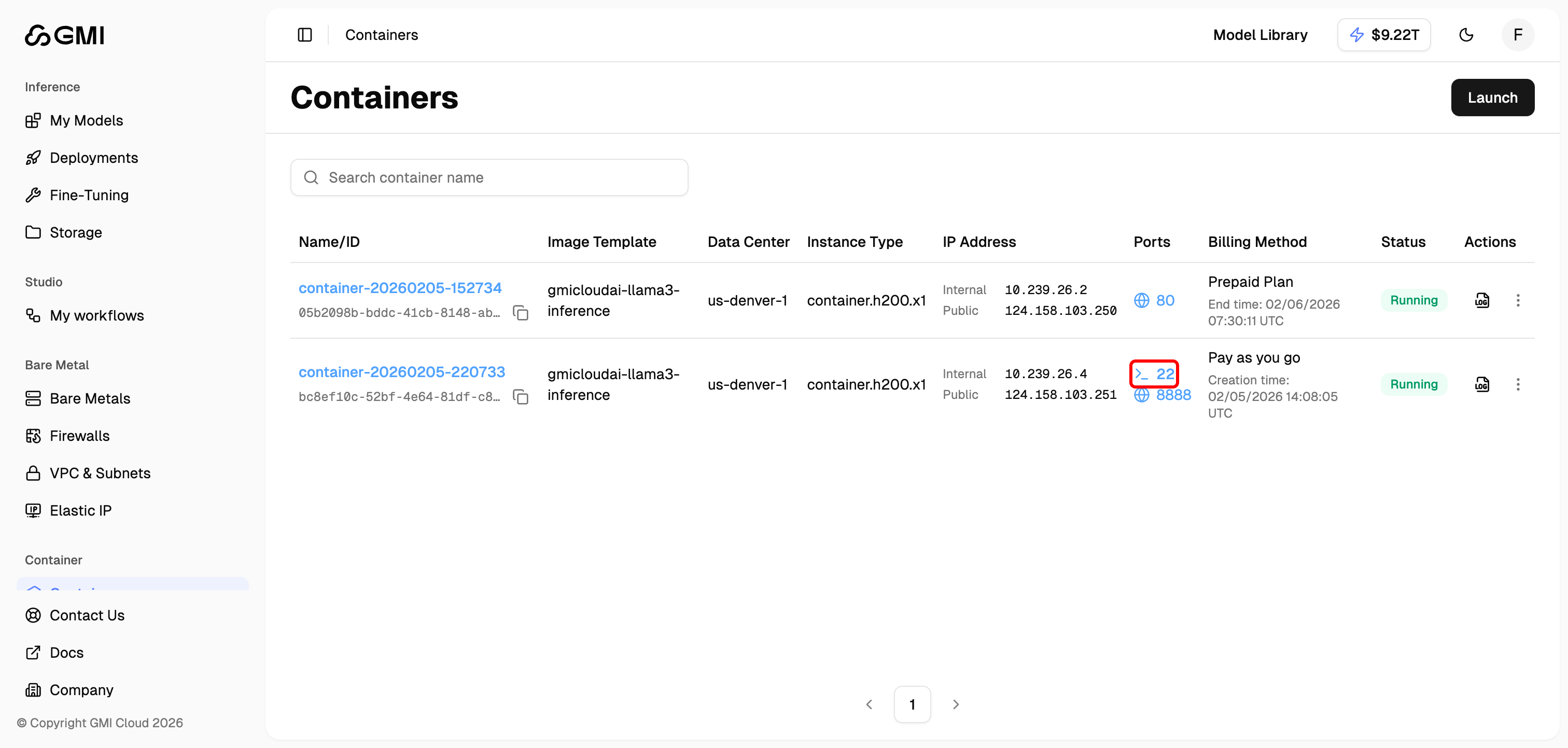
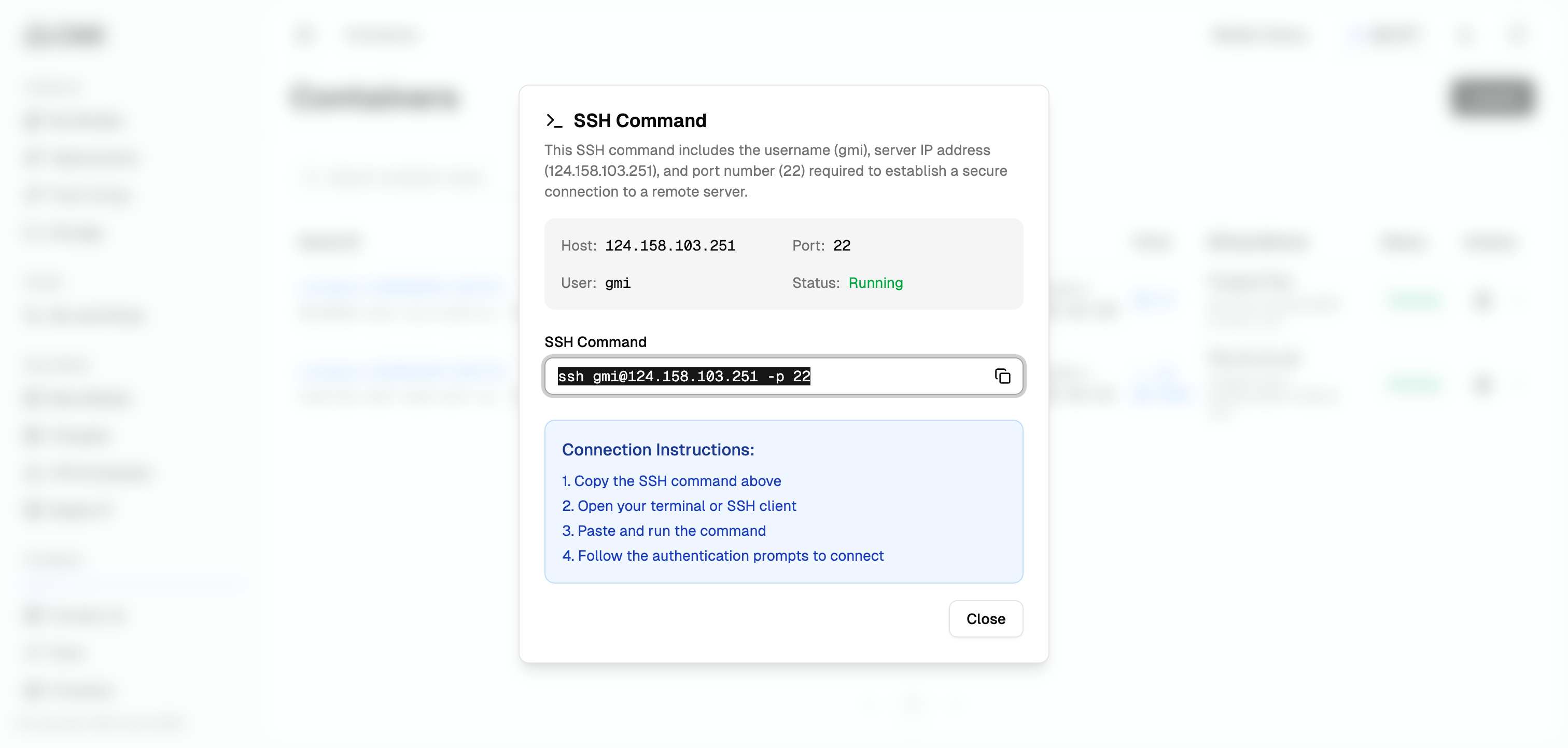
- In the pop-up window, copy the SSH command and paste it into your terminal
Connect via Jupyter Notebook
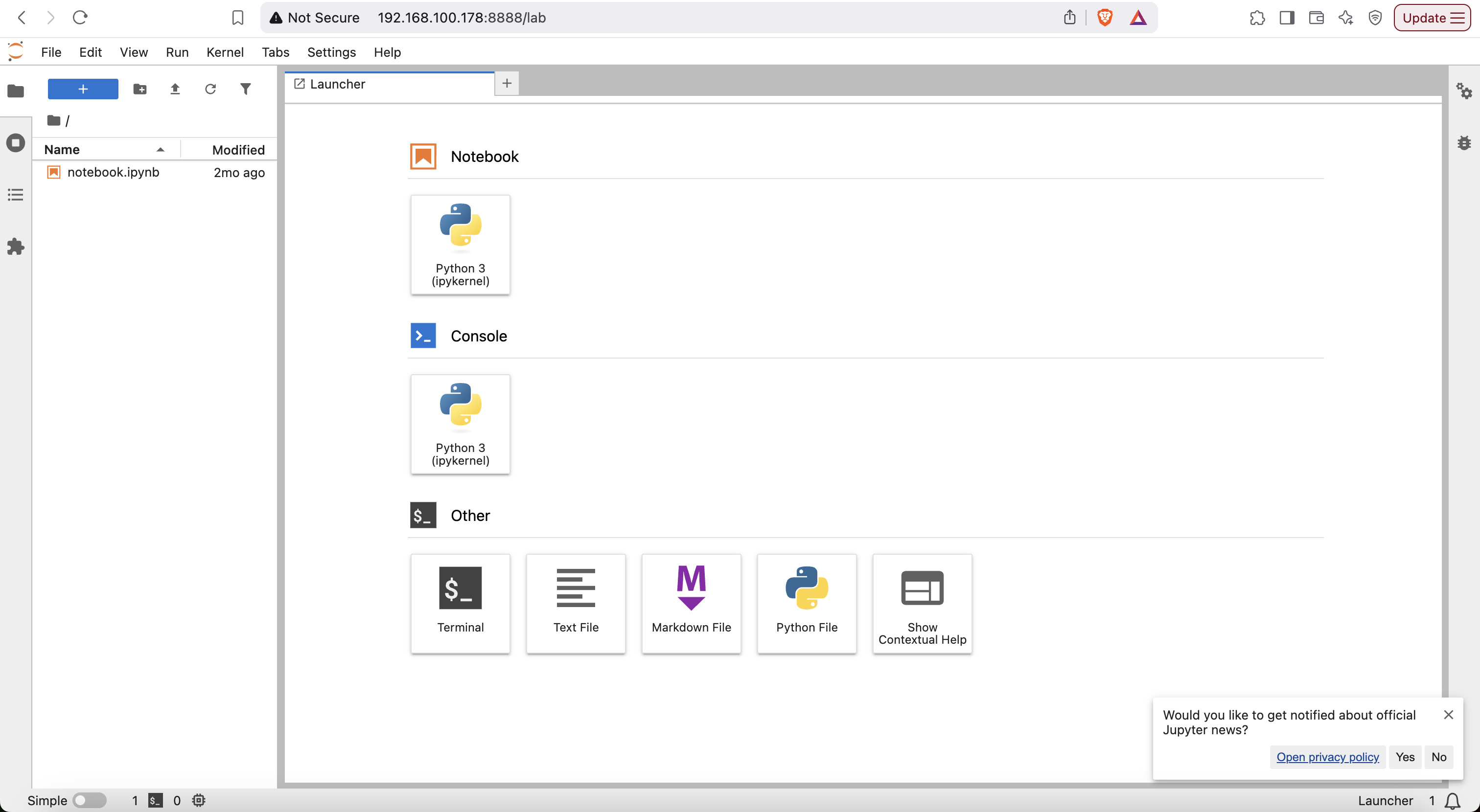
- Locate a container and click the port “8888” icon in the “Ports” field
- A Jupyter Notebook web page will open in another browser tab
Open a Web Shell
Access a web-based terminal directly in your browser, no SSH client required.- Locate the container you want to access
- Click the “More actions” button (three dots icon)
- Select “Open Shell” from the dropdown menu
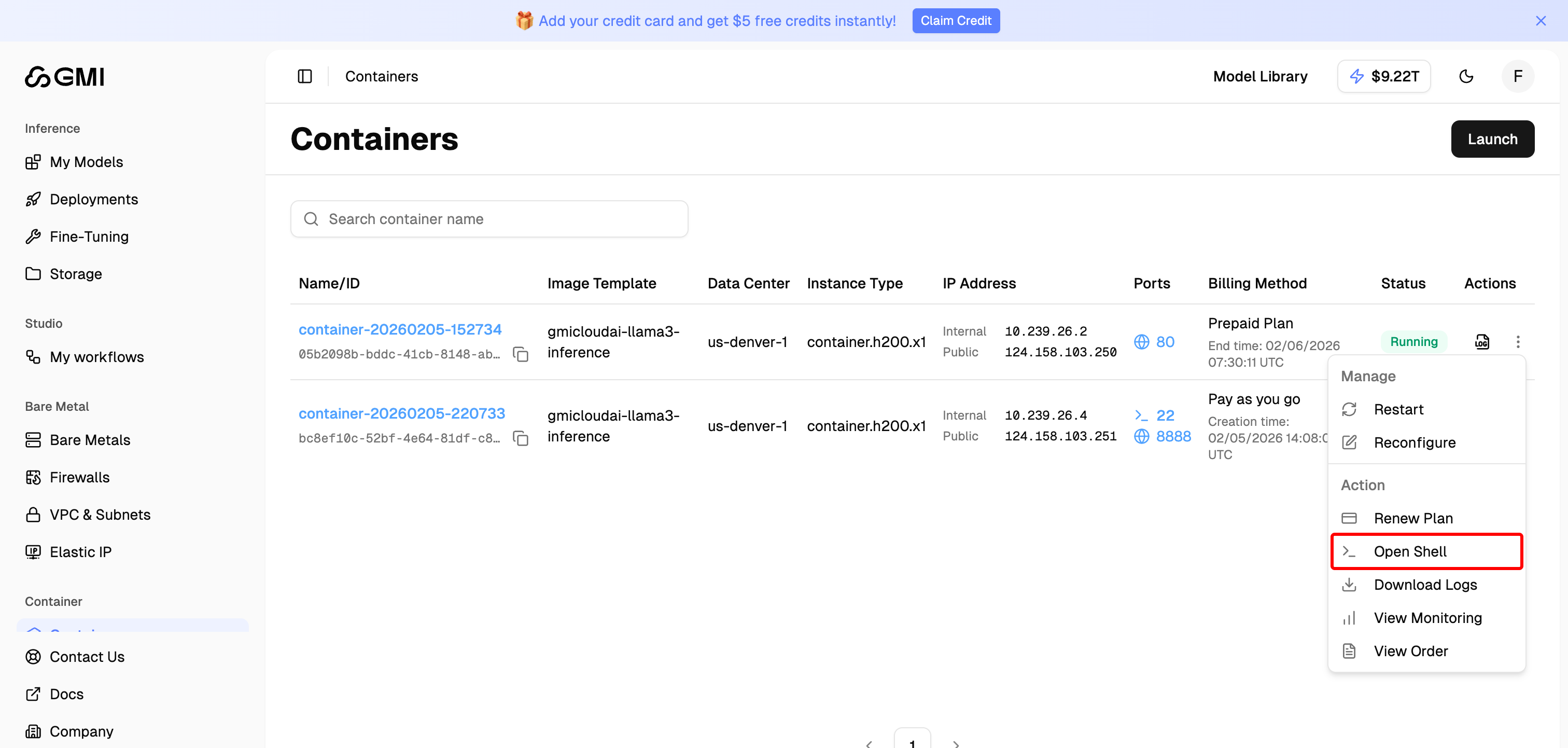
- A new browser tab will open with a web-based terminal connected to your container
Container Status Reference
Lifecycle Actions
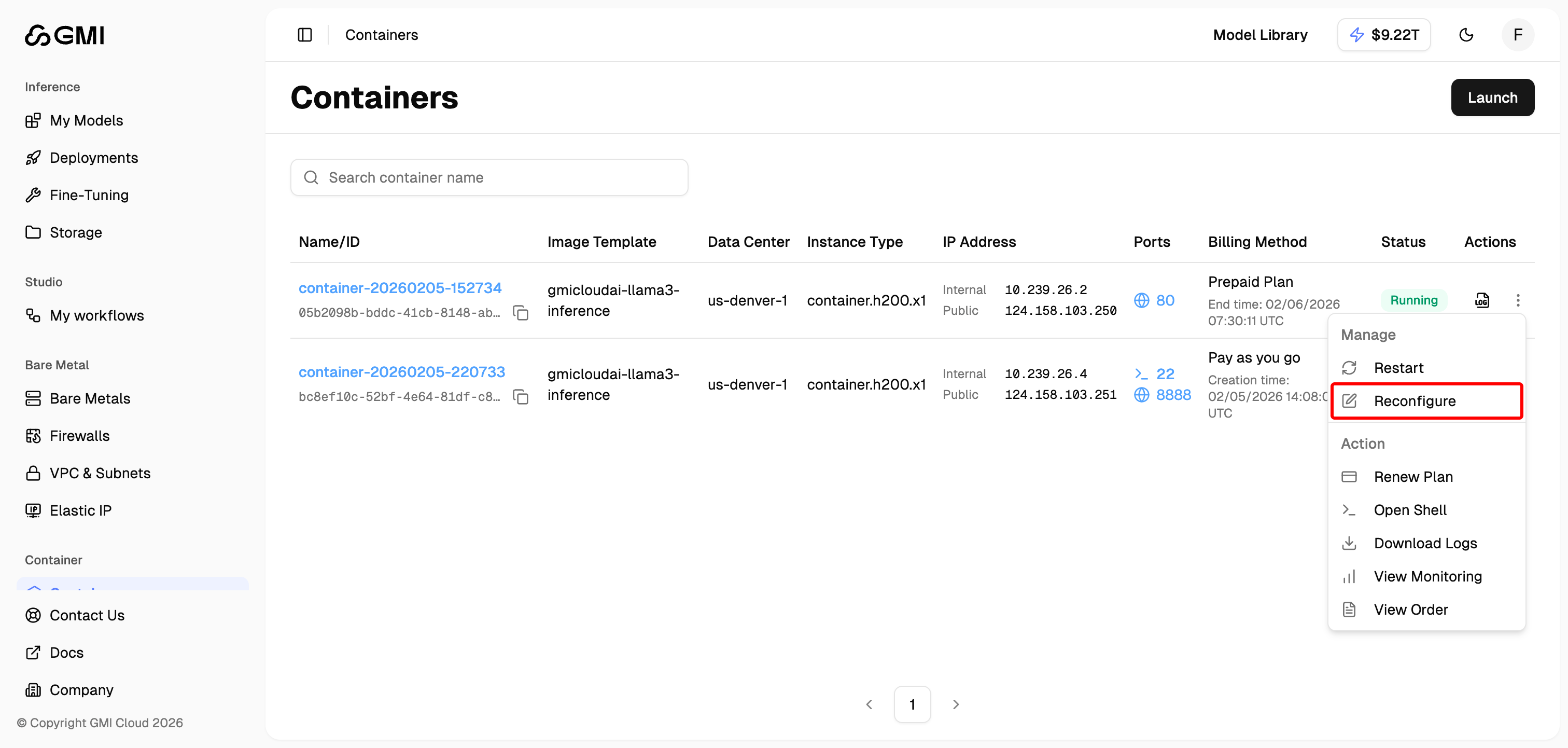
These actions change the state of a container. Open the “More actions” menu (three dots) on a container row to reach them.Reconfigure
- Locate the container you want to reconfigure and click “Reconfigure” from the dropdown menu in the “Action” field
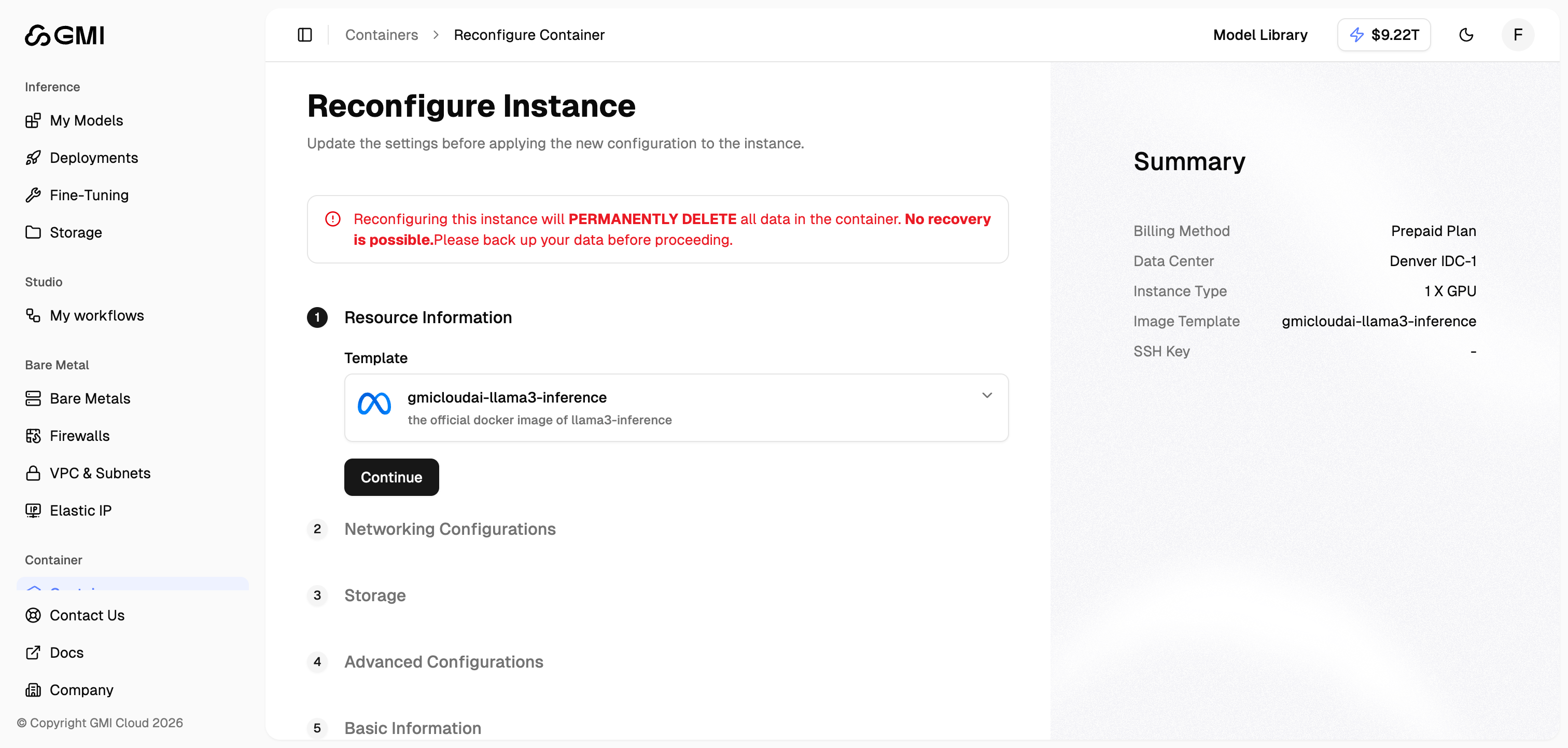
- Edit the settings of the original container as you wish, one by one
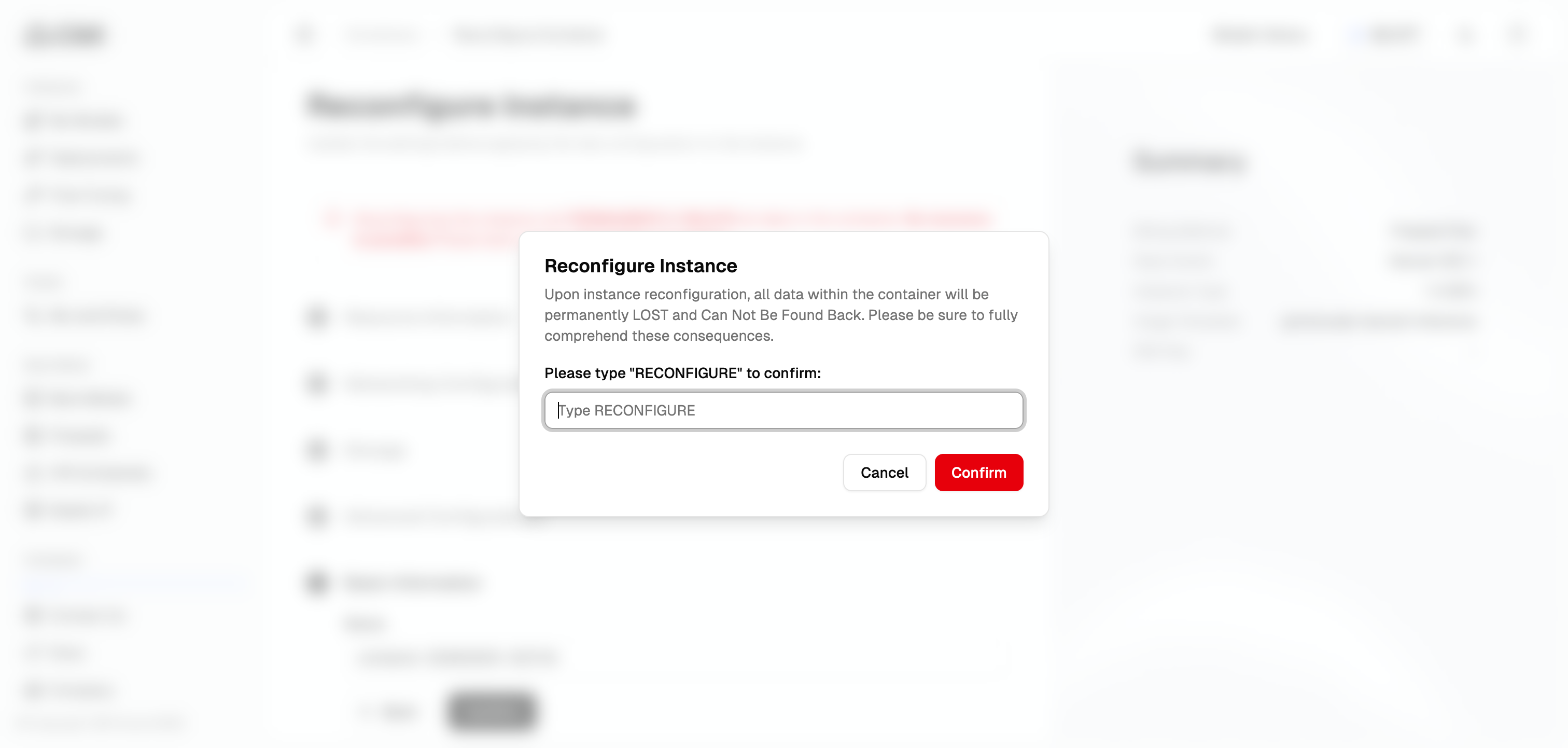
- Type “RECONFIGURE” in the pop-up window to confirm the new settings and start the instance with the new settings
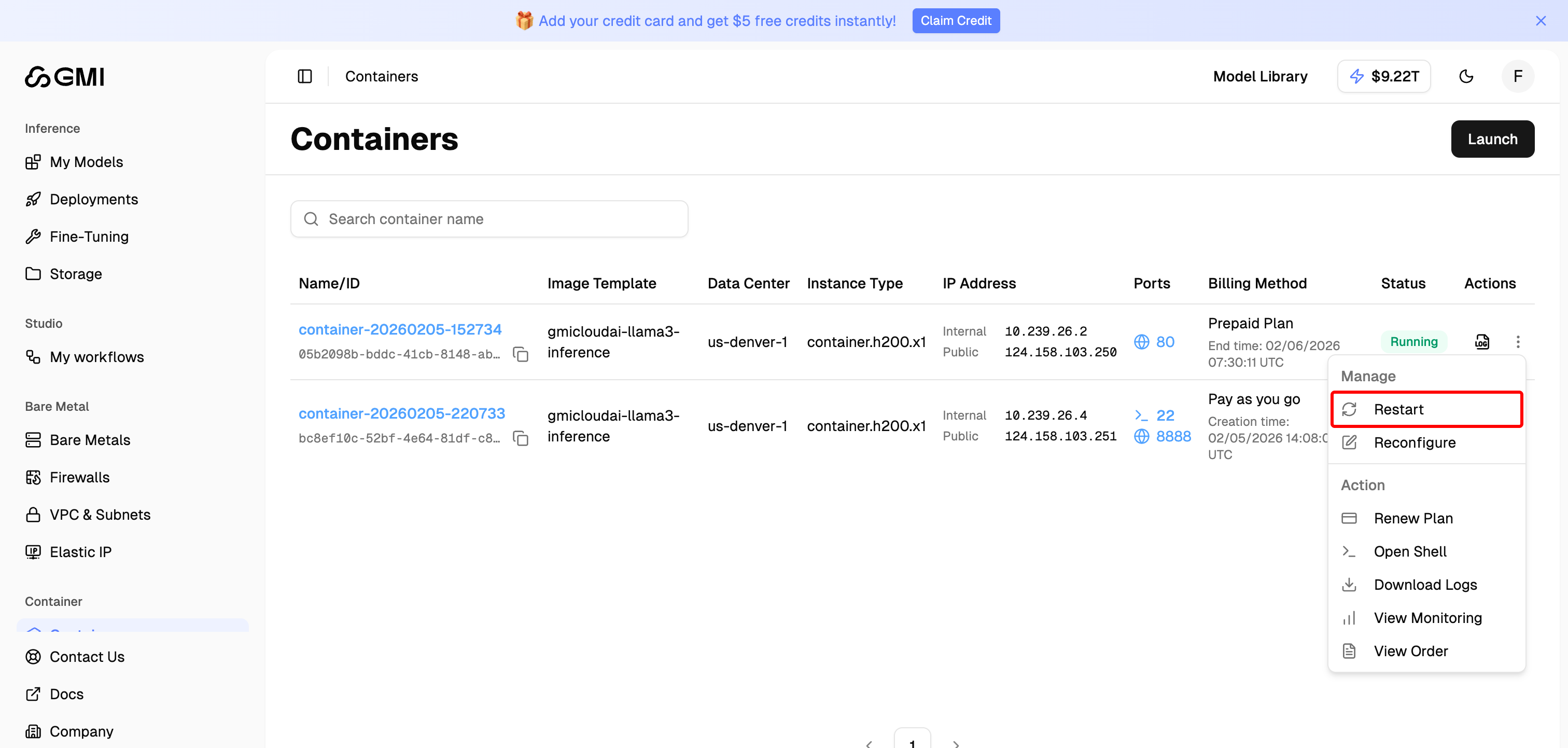
Restart
- Locate the container you want to restart
- Click the “More actions” button (three dots icon)
- Select “Restart” from the dropdown menu
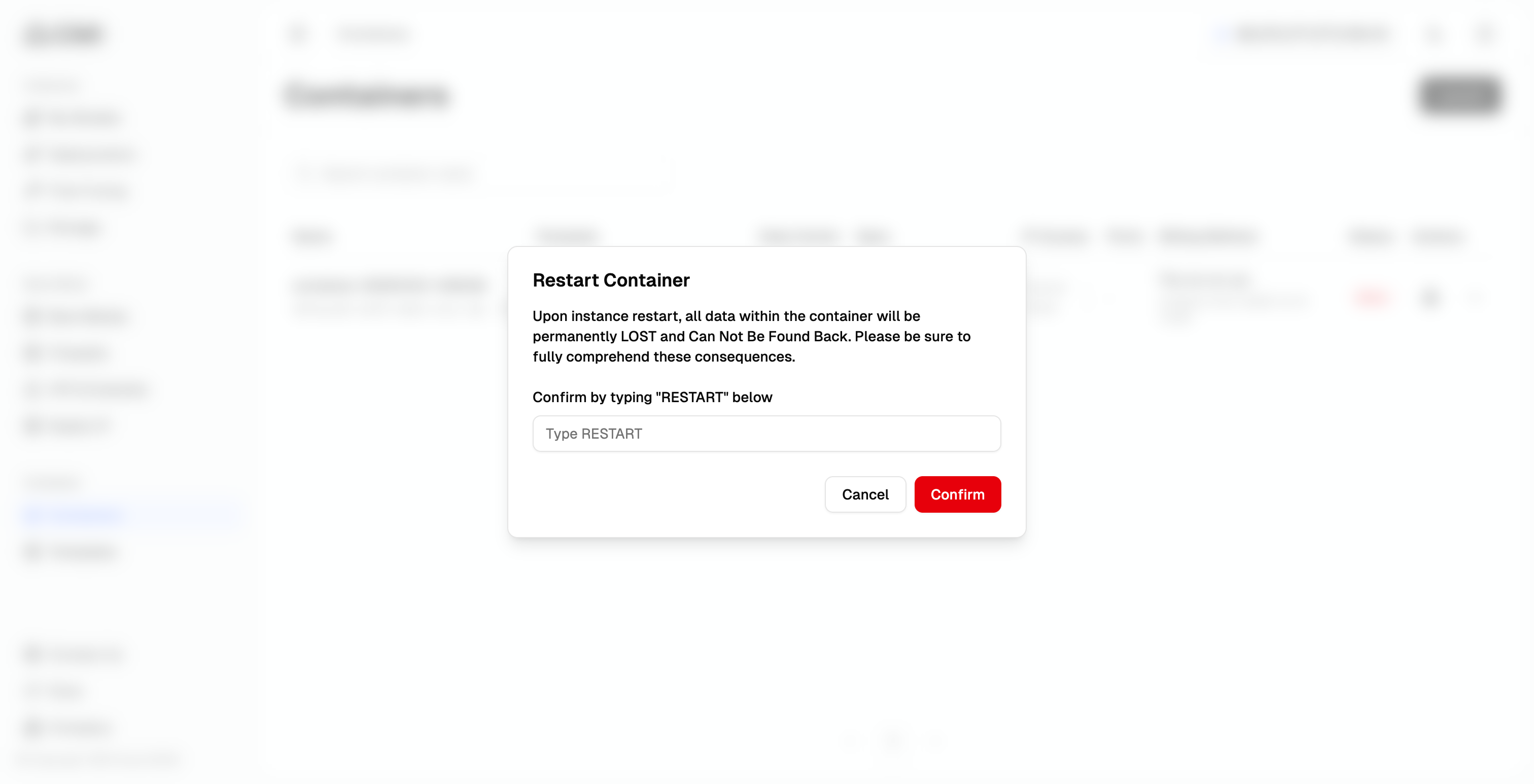
- Enter the confirmation text as shown in the dialog
- Click “Confirm” to proceed
Renew
The Renew feature extends the rental period of a Prepaid Plan container to keep your resources running uninterrupted.The Renew option is only available for containers with Prepaid Plan billing method. Pay-as-you-go containers do not have an expiration date and therefore do not need renewal.
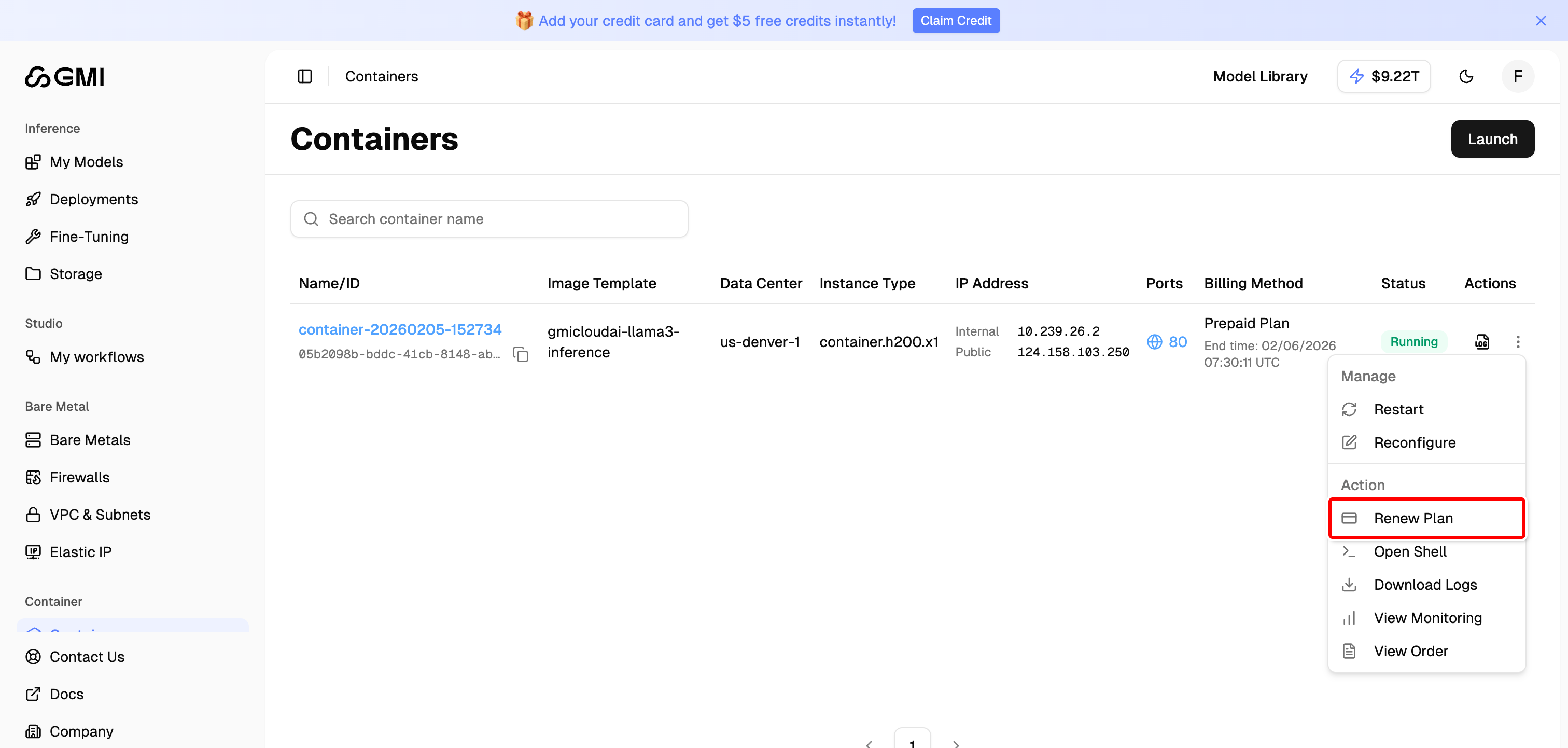
- Locate the container you want to renew
- Click the “More actions” button (three dots icon)
- Select “Renew Plan” from the dropdown menu
- On the Renew Container page, you will see:
- Instance Information: Container name, billing method, current end time, and new end time
- Extension Duration: Select how long you want to extend the container
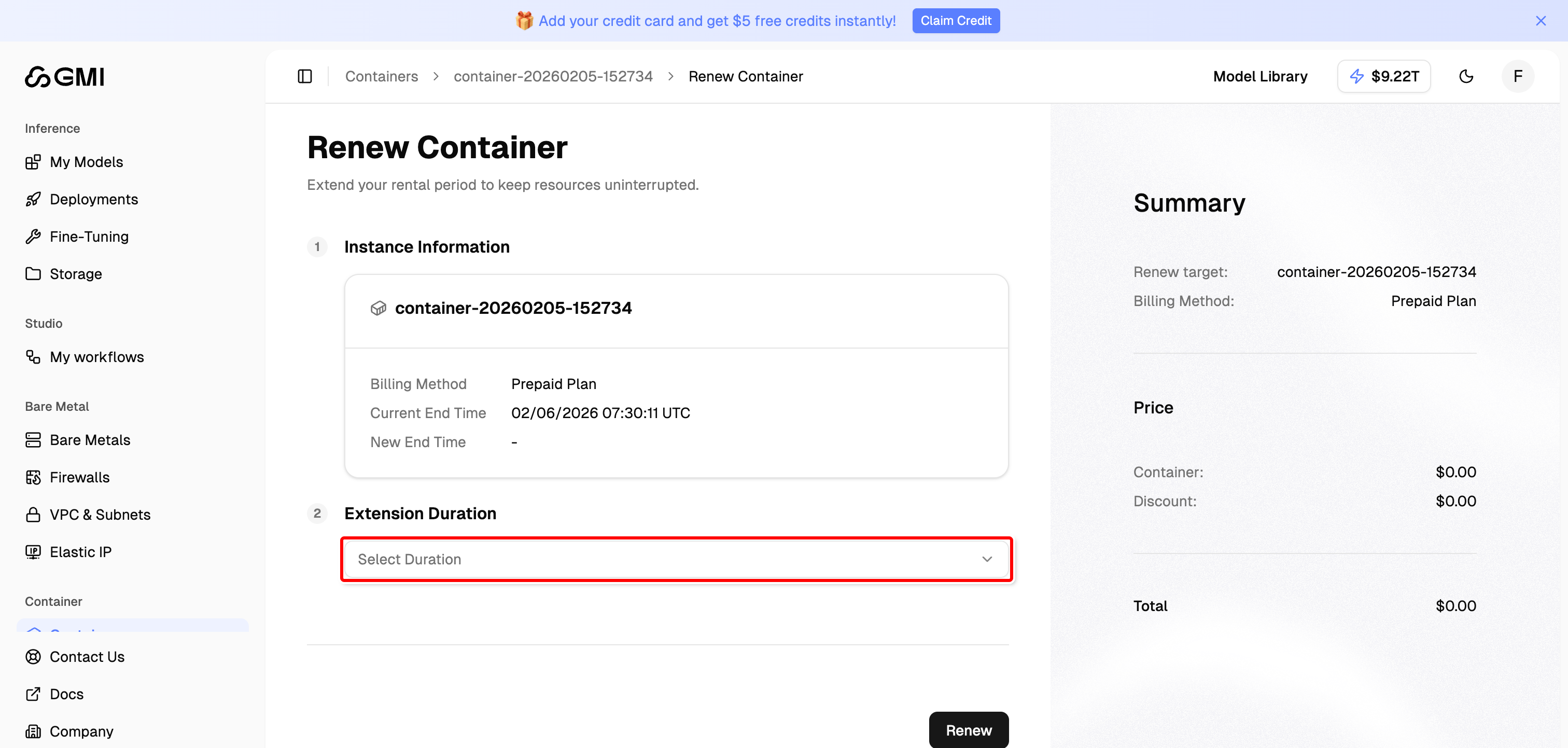
- Click the “Select Duration” dropdown to choose your extension period. Available options include:
- Short-term: 1 day, 3 days, 1 week, 2 weeks, 3 weeks
- Monthly: 1 month through 11 months
- Long-term: 1 year, 3 years
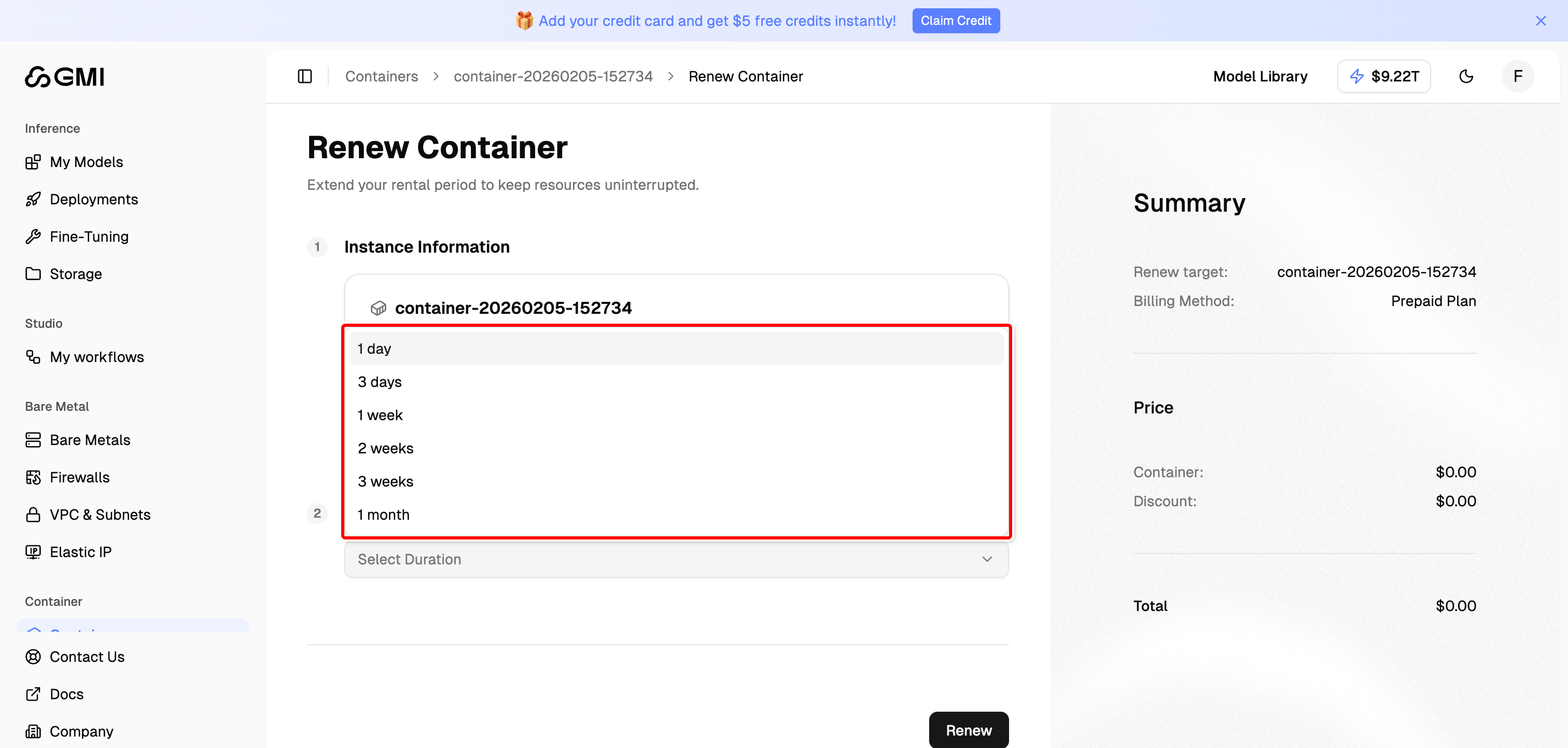
- After selecting a duration, review the updated New End Time and the Price summary
- Click “Renew” to proceed to payment
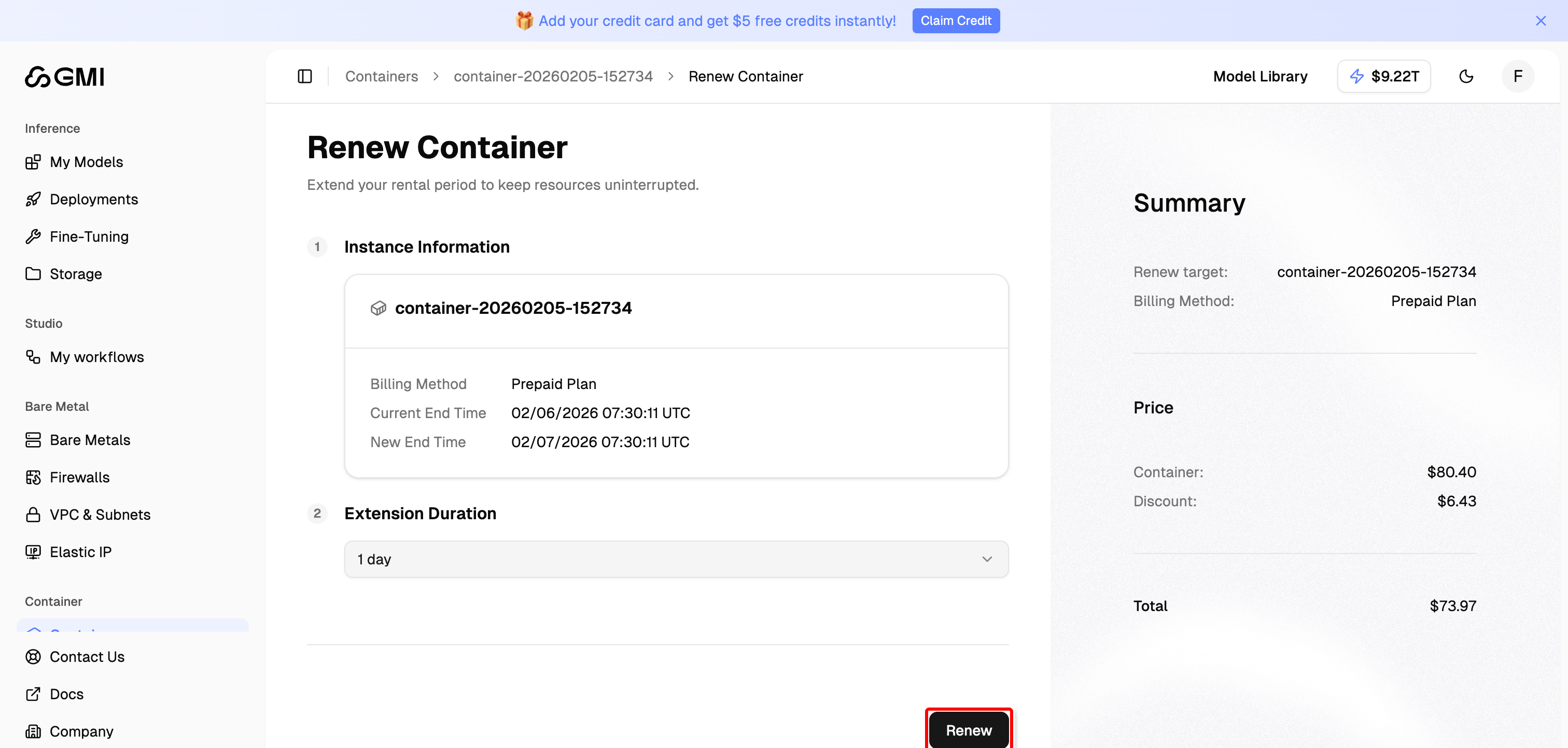
- Complete the payment process to finalize the renewal
Terminate
The Terminate option is only available for containers with Pay as you go billing method. Prepaid Plan containers cannot be terminated before their rental period ends.
- Locate the container you want to terminate
- Click the “More actions” button (three dots icon)
- Select “Terminate” from the dropdown menu

- Review the dialog, if the container has an Elastic IP attached, note that the EIP will NOT be automatically released. You must manually release it from the Elastic IP console afterwards if you no longer need it
- Type
TERMINATEin the confirmation field - Click “Confirm” to proceed

Networking
Modify a running container’s networking attachments from its Detail page (click the container name in the list to open it). These changes apply immediately without restarting the container.Associate EIP
Attach an Elastic IP to give the container a public IP address. Do this before associating a firewall. On its own, an EIP does not allow any traffic through, a firewall must be attached afterwards to permit inbound connections.- Open the container’s detail page
- In the Networking Configurations section, click “Associate EIP”

- In the dialog, select an Elastic IP from the Elastic IP Address dropdown (only Disassociated EIPs in the same data center as the container are listed)

- Click “Confirm” to attach the EIP
If no EIPs appear in the dropdown, allocate one from the Elastic IP page first, see Allocate an Elastic IP.
Associate Firewall
Attach a firewall to a container that has an EIP but no firewall associated. Only do this after an EIP is associated.- Open the container’s detail page
- Scroll to the Firewalls section and click “Associate Firewall”

- In the dialog, select a firewall from the Firewall dropdown (only firewalls in the same data center as the container are listed)

- Click “Confirm” to attach the firewall
To change an existing firewall, disassociate the current one first (see below), then associate a new one. Alternatively, manage associations from the Firewalls page, see Associate a Firewall with Instances.
Disassociate Firewall
Remove the firewall currently attached to the container. Do this before disassociating the EIP. Once the firewall is removed, no inbound traffic is allowed through the EIP until you associate another firewall with the appropriate rules.- Open the container’s detail page
- Scroll to the Firewalls section and click “Disassociate Firewall”

- In the confirmation dialog, type
DISASSOCIATEto confirm

- Click “Confirm” to detach the firewall
Without a firewall, the container will not accept any inbound connections even if it has an EIP. To resume inbound traffic, associate another firewall, see Associate a Firewall with Instances.
Disassociate EIP
Detach the Elastic IP from the container. Disassociate the firewall first before removing the EIP. The EIP returns to your account as Disassociated, you can associate it with another instance later or release it entirely (see Elastic IP).- Open the container’s detail page
- In the Networking Configurations section, click “Disassociate EIP”

- In the confirmation dialog, type
DISASSOCIATEto confirm

- Click “Confirm” to detach the EIP
Operations & Monitoring
Day-to-day observability, these actions read container state without changing it.View Logs
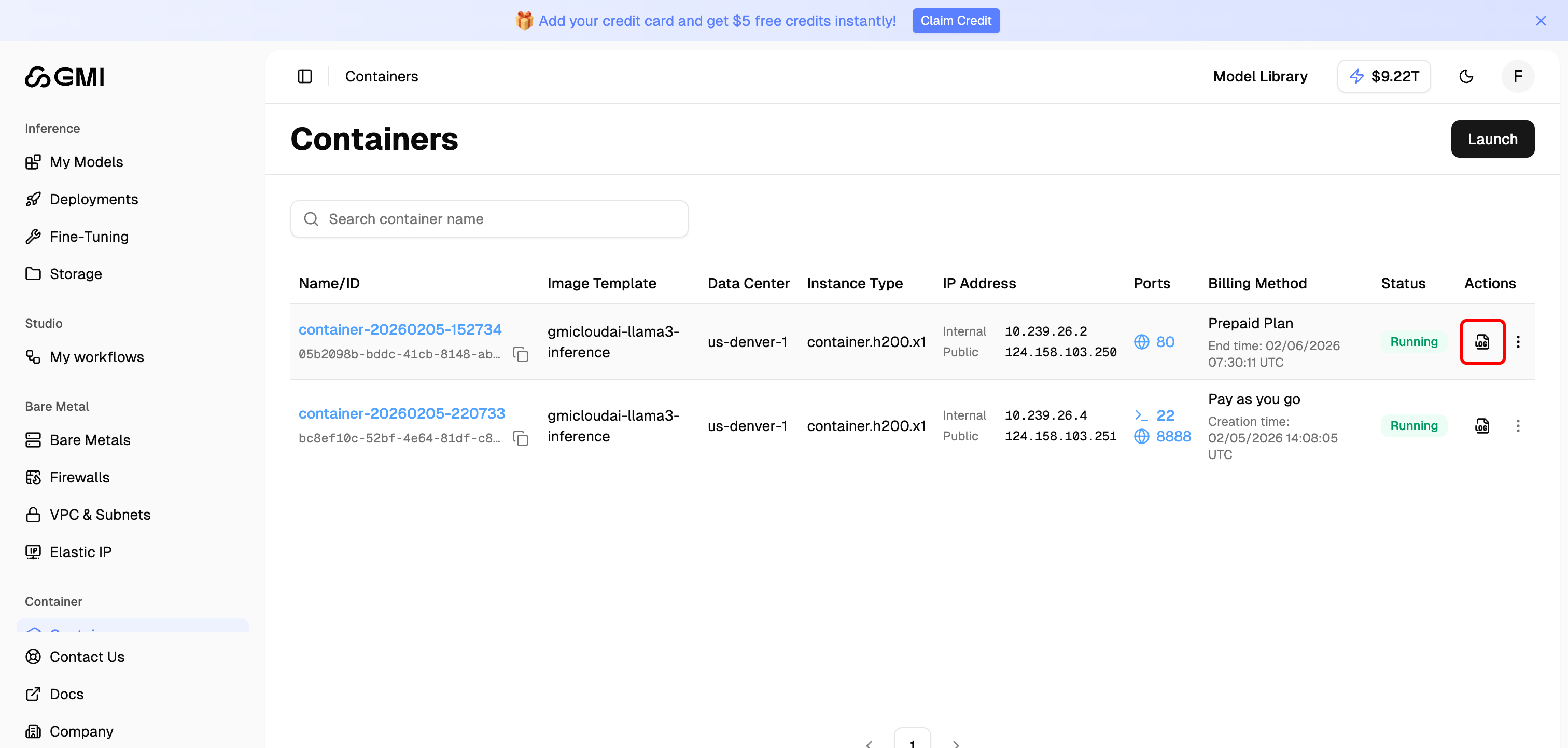
- Locate the container whose logs you want to view
- Click the “View Log” icon to access the logs
Download Logs
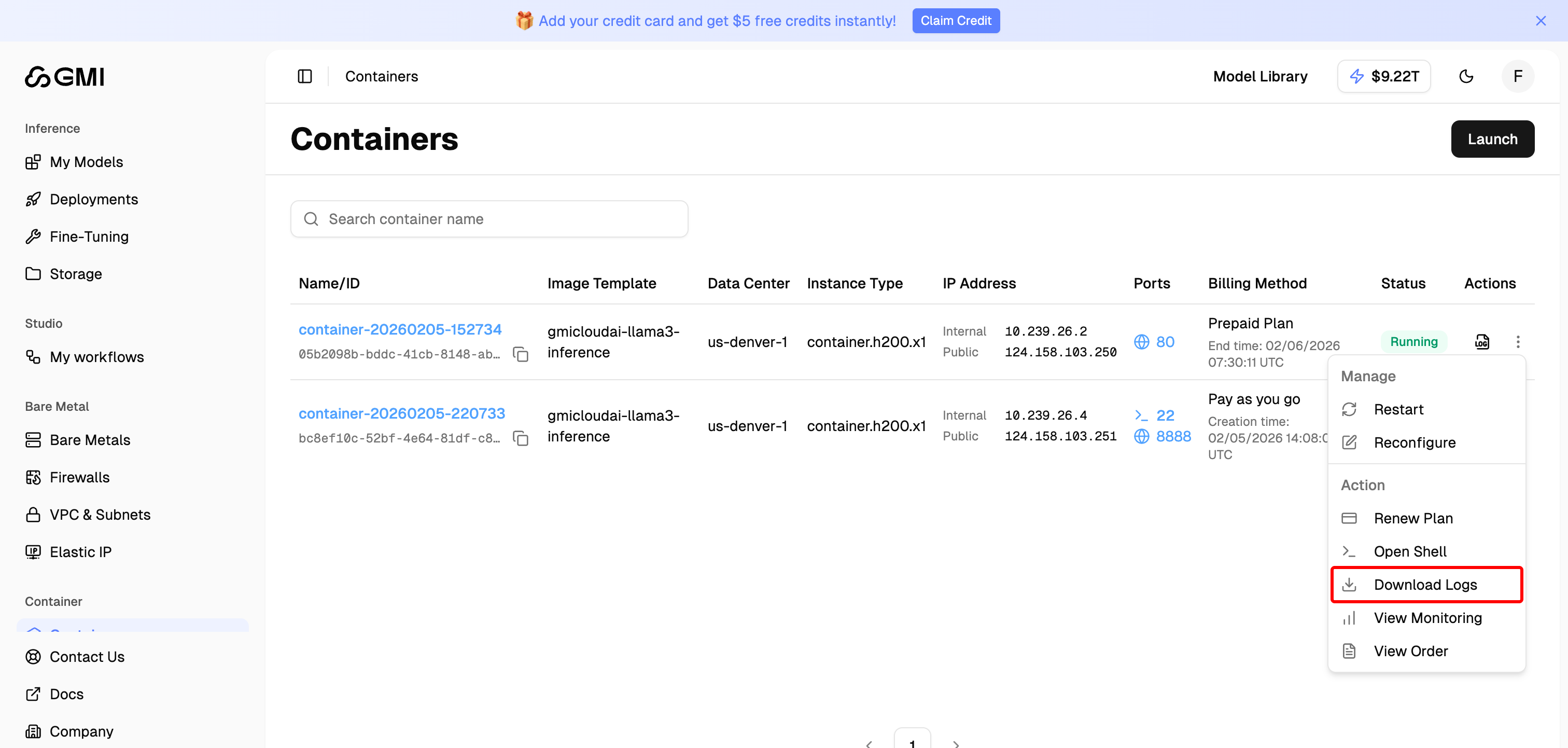
- Locate the container whose logs you want to download
- Click the “More actions” button (three dots icon)
- Select “Download Logs” from the dropdown menu to download the logs
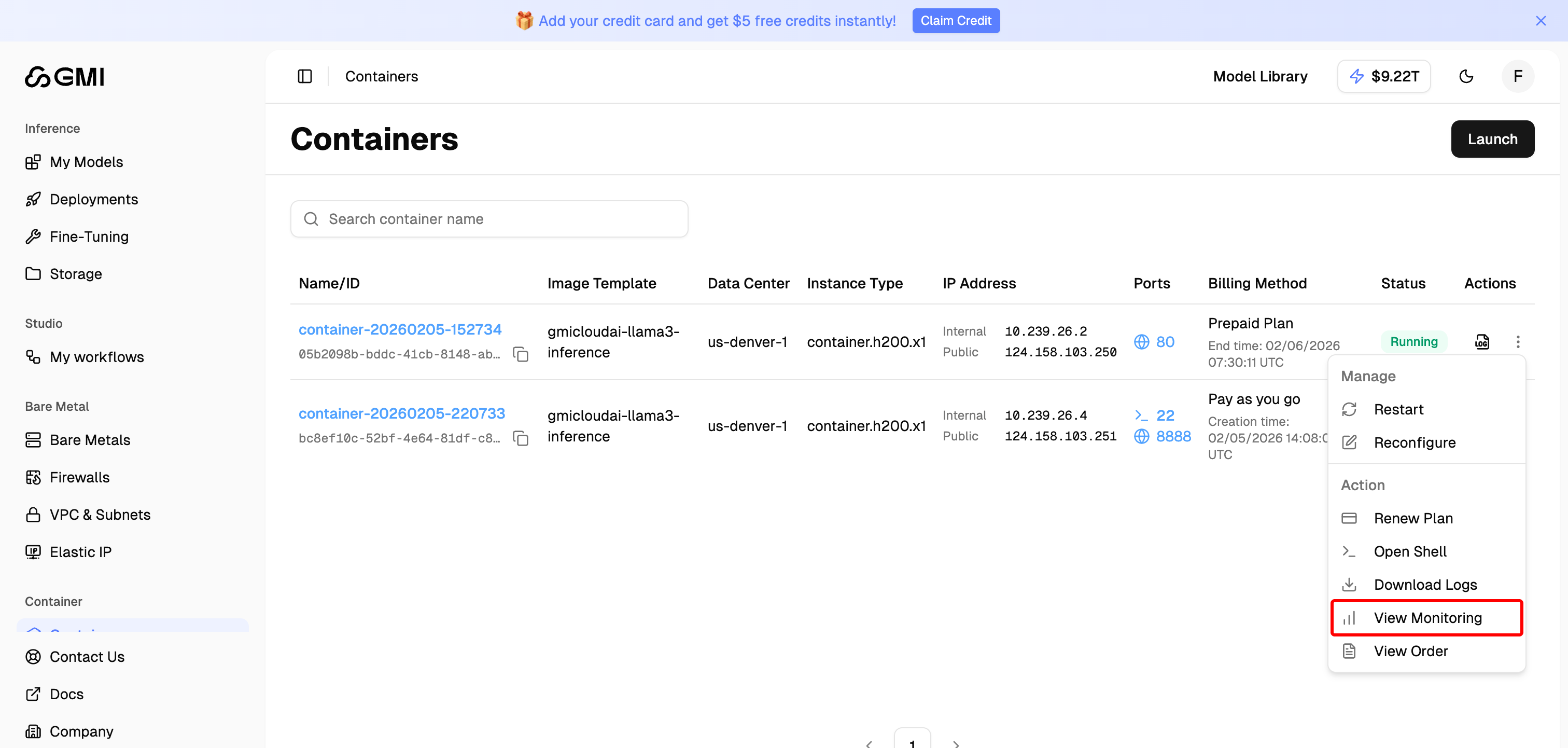
View Monitoring
Monitor your container’s resource usage including GPU, CPU, and memory metrics.- Locate the container you want to monitor
- Click the “More actions” button (three dots icon)
- Select “View Monitoring” from the dropdown menu
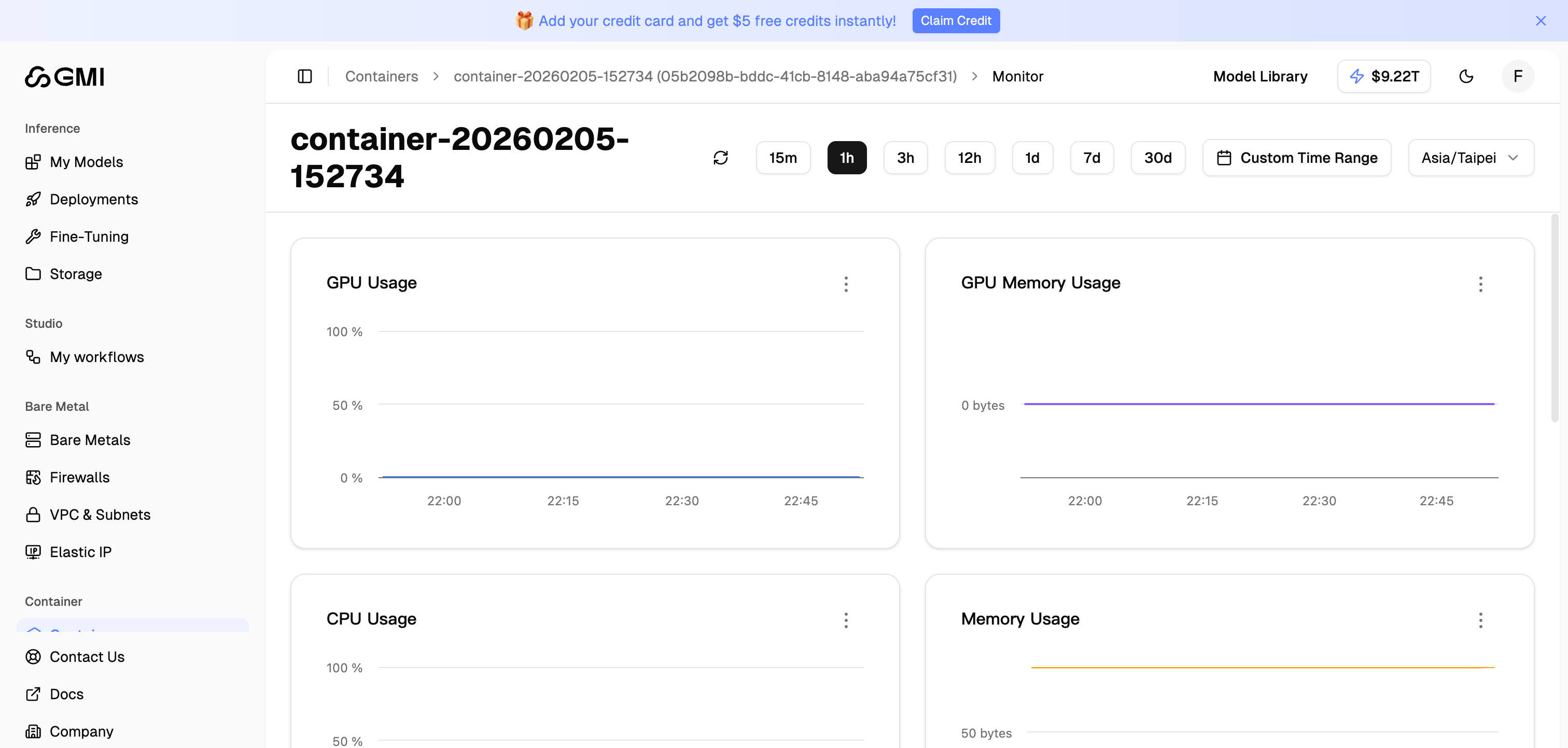
- The monitoring dashboard displays:
- GPU Usage: Real-time GPU utilization percentage
- GPU Memory Usage: GPU memory consumption
- CPU Usage: CPU utilization percentage
- Memory Usage: RAM consumption
View Order
View the billing and payment details for your container.- Locate the container whose order you want to view
- Click the “More actions” button (three dots icon)
- Select “View Order” from the dropdown menu
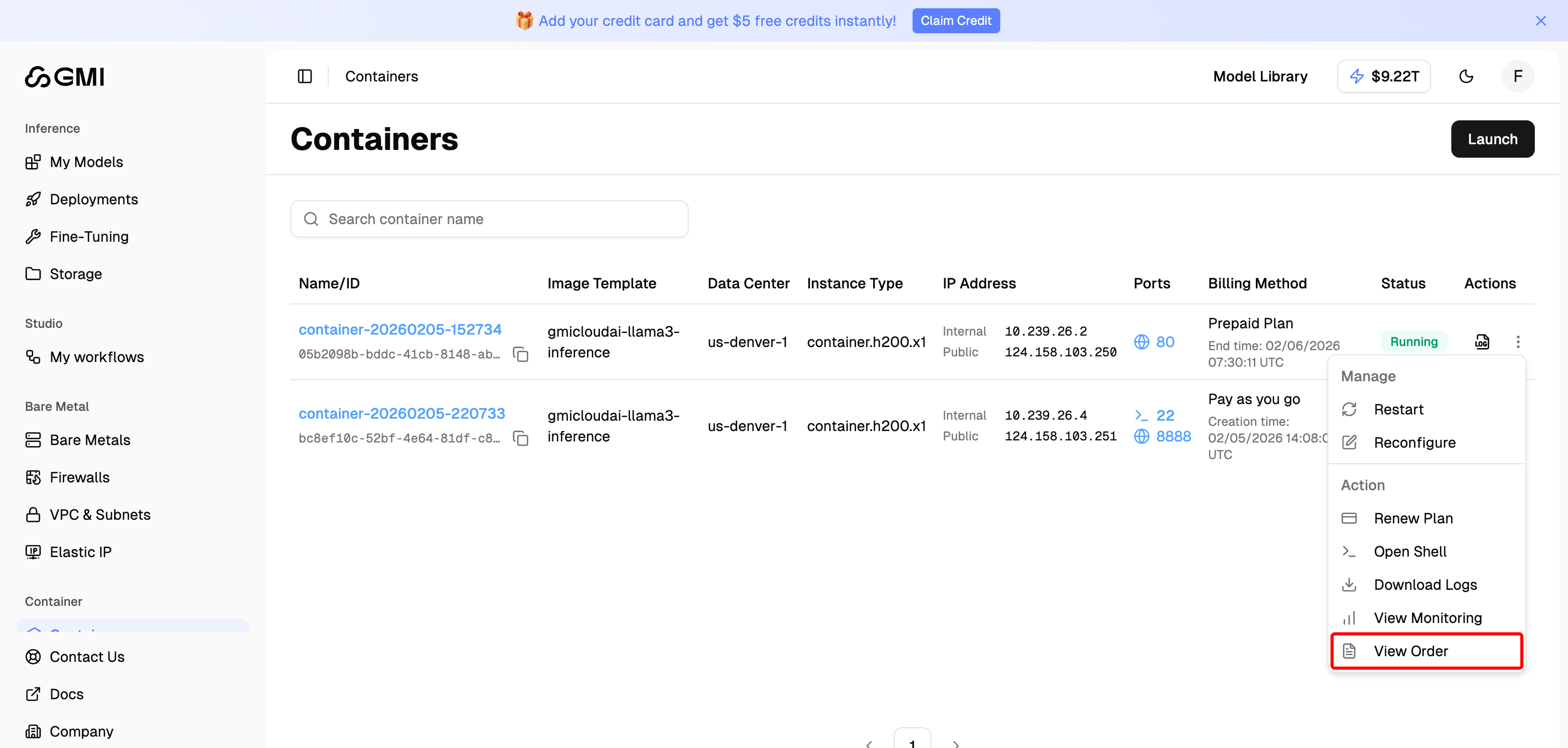
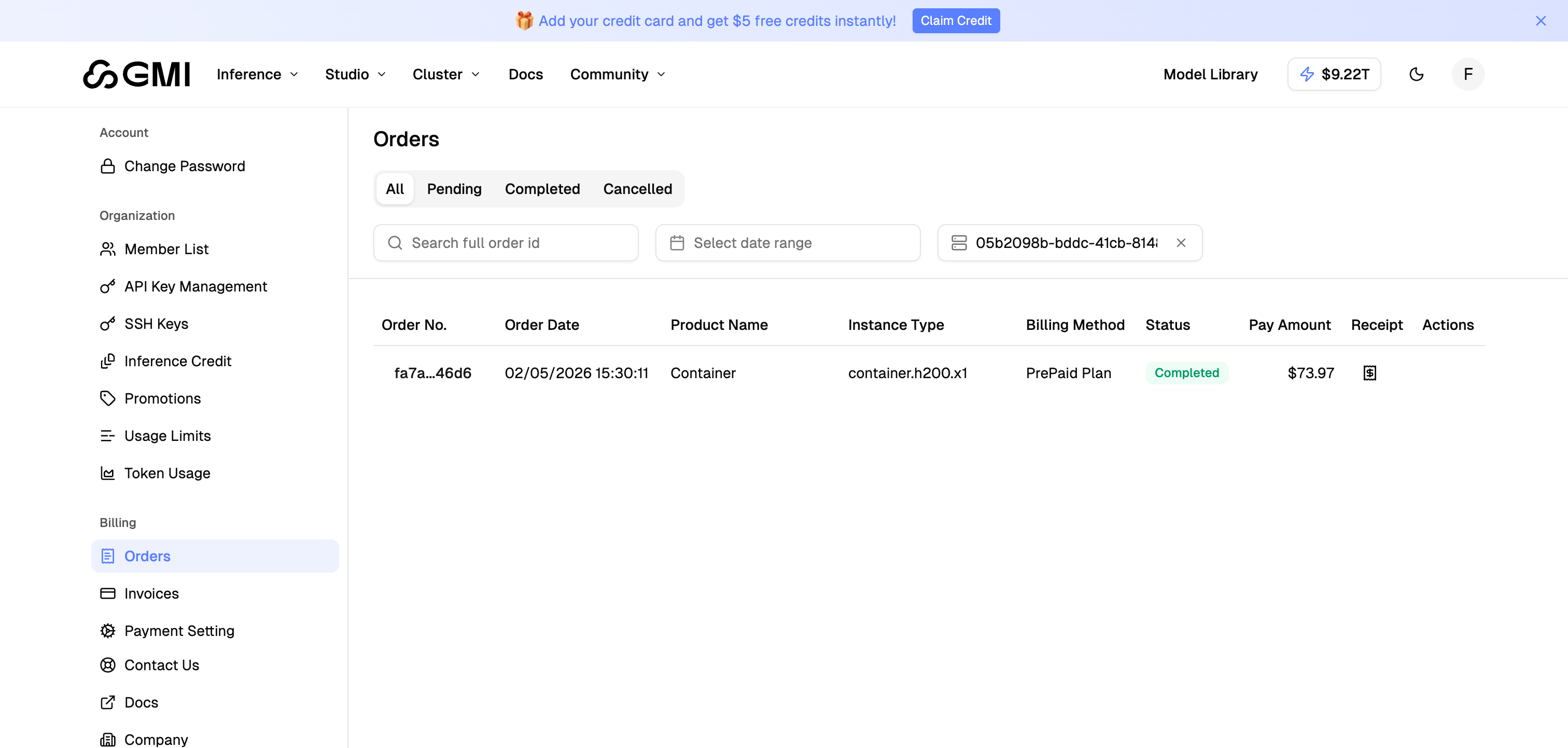
- The Orders page displays your container’s order information including:
- Order No.: Unique order identifier
- Order Date: When the order was placed
- Product Name: Type of resource (Container)
- Instance Type: The container instance specification
- Billing Method: Prepaid Plan or Pay as you go
- Status: Order status (Completed, Pending, Cancelled)
- Pay Amount: Total amount charged
- Receipt: Download receipt for the order