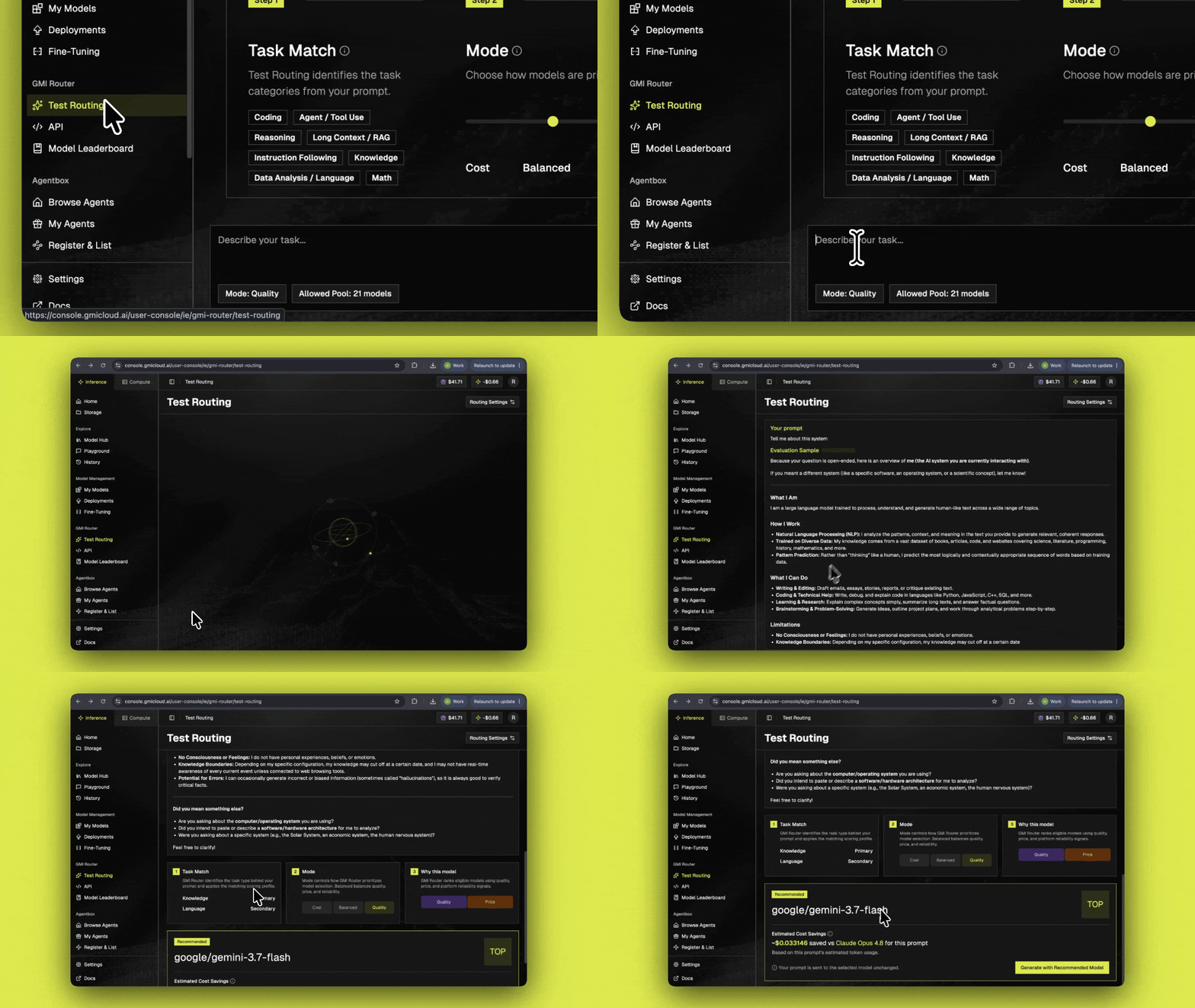
The GMI Router turns a plain-language request into the right model for the job. You send an intent or a full chat, and the API ranks the eligible models by task-category fit, quality, and cost, then either hands back a ranked list or routes the request straight to the best model and returns the completion. Access the playground here: https://console.gmicloud.ai/user-console/ie/gmi-router/test-routing GMI Router Ui

How routing works

Autoroute treats model selection as a process, not a single guess. Every Autoroute request moves through the same sequence:
  1. Understand. The router reads your latest message and classifies the task and its requirements.
  2. Compare. It scores the allowed model pool across quality, cost, and latency.
  3. Validate. The top candidate is checked before it is committed. A high score alone does not win the request.
  4. Select. The router locks in the winning model.
  5. Respond. The selected model generates the completion, returned inline or streamed token by token.
The flow, at a glance: Prompt -> Understand -> Compare -> Validate -> Select -> Respond. Two ways to use it:
  • /autoroute picks the model and returns the completion in one call. Streaming is the default.

Authentication

Base URL: https://console.gmicloud.ai/api/v1/ie/recommendation Send a bearer token in the Authorization header: Authorization: Bearer YOUR_TOKEN Most routed responses include an X-Recommendation-ID header. It is absent on auth and early validation errors. Keep this value if you plan to submit feedback later.

Quick start: Autoroute

Send an OpenAI-style messages[] array. The router reads the latest user message, ranks the model pool, and generates with the top candidate.
Non-streaming response:

Request fields

Streaming vs non-streaming

  • Streaming (default). Returns text/event-stream. Chunks are proxied as they arrive, followed by a routing_metadata event, then [DONE]. One backup model may be tried before the first token on a 5xx, provider error, 429, or a 10-second first-token timeout. Once tokens start flowing, no further fallback happens; a mid-stream failure keeps the partial output, sends an error event, and closes the stream.
  • Non-streaming (stream: false). Returns one JSON object with up to two ordered backups on a transient failure (5xx, provider error, 429, or a 30-second timeout).
The router is stateless. Resend the full conversation on every request.

Quick start: Recommendations

Get a ranked list of models without generating anything.
Response:
Notes on the response:
  • estimated_cost_savings appears only on the top recommendation, and only when the estimate is positive.
  • V1 recommends LLMs only, so category is always llm.

Request fields

Submitting feedback

Feedback is write-once per recommendation. Use the recommendation_id from a recommendation or from autoroute routing metadata.
Rules:
  • signal is up or down.
  • For down, include one or more reasons with no duplicates.
  • For up, omit reasons entirely.
  • A second submission for the same recommendation returns 409.
Allowed reasons: not_the_model_i_want, wrong_task_type, model_quality_poor, too_slow, cost_not_meaningfully_lower, model_unavailable, not_allowed_by_policy, prefer_another_model, other.

Routing settings

Routing settings define which models are eligible and how they are ranked. Org owners set the hard bounds; each user sets a preference within those bounds. Defaults when fields are omitted on the org update: model scope all, mode balanced, and Auto Mode on.

Health checks

Both are unauthenticated.

Status codes